In the first of our series of contributions from organisations working with internationally qualified health professionals across Australia, we are publishing the Foreword from the research report, Migration, mobility and Australia’s healthcare workforce: Towards a people-centred approach. Maria Dimopoulous, CEO of the Settlement Council of Australia explains here why the report resonates with the work of her organisation…
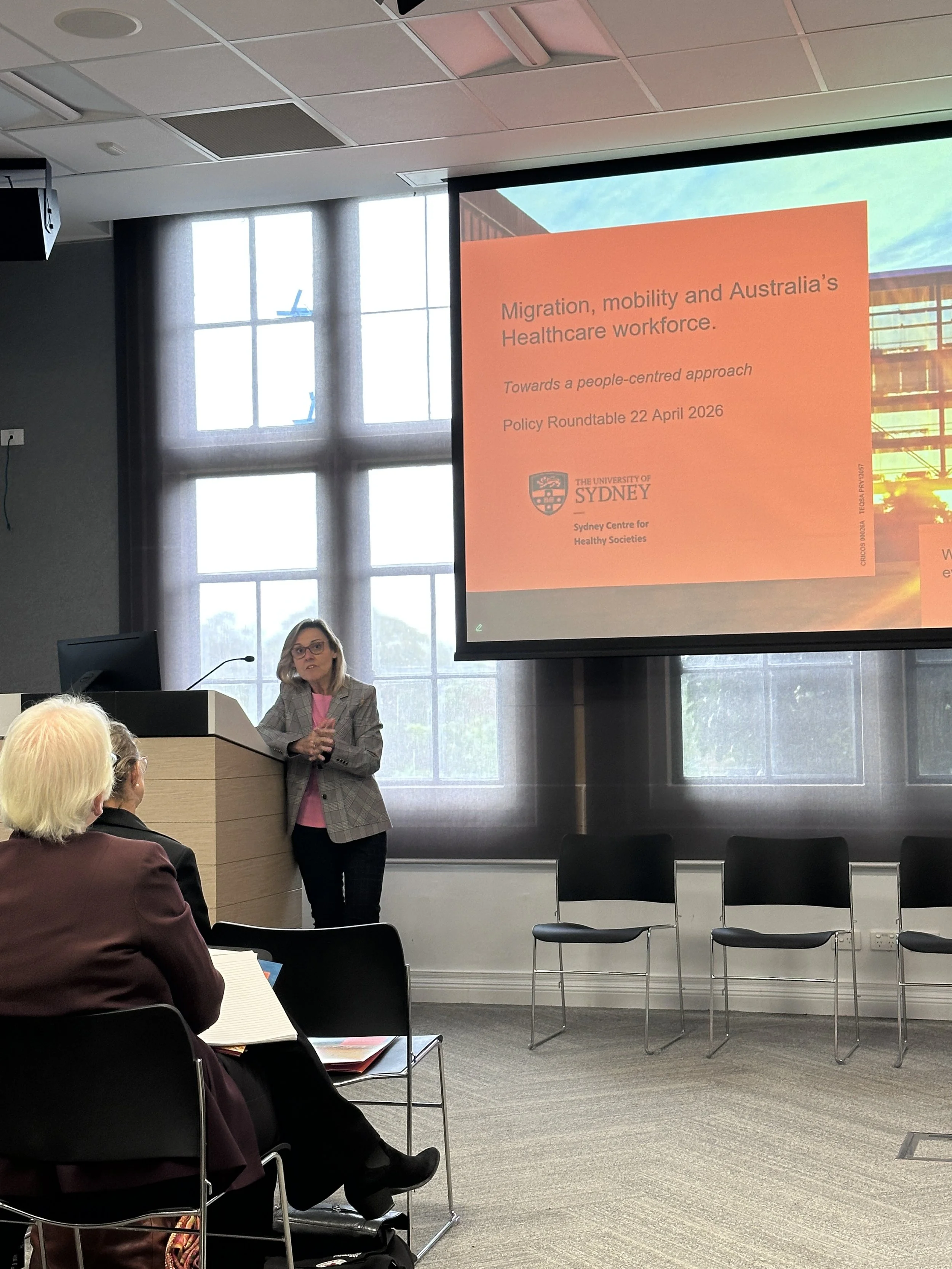
Maria Dimopoulos addresses attendees at the Networks of Care Policy Roundtable at The University of Sydney.
April 2026
Foreword to the report:
Australian migration policy is increasingly organised around the language of productivity, labour shortages, workforce demand and economic contribution. This report insists upon a broader and more intellectually serious proposition: migration policy is also about the conditions through which people establish trust, participation, continuity and belonging within the life of a nation.
“The work of Dr Leah Williams Veazey and Dr Alexandra Block makes an important contribution to contemporary migration discourse because it restores humanity, relationality and complexity to debates that are too often reduced to administrative throughput and labour market demand. Their research places internationally qualified healthcare professionals back within the realities through which migration is actually lived, through family, care, identity, aspiration, culture, professional recognition and community life.”
For the Settlement Council of Australia, this framing carries profound significance. The settlement sector has long understood that migration outcomes are shaped not simply by arrival or workforce participation, but by whether people are able to build coherent and sustainable lives within the communities in which they live and work. Stability, institutional trust, access to housing and childcare, cultural recognition, community connection and long-term security all shape whether participation deepens into belonging.
This report demonstrates with considerable clarity that these dynamics shape the experiences of skilled migrants as profoundly as they shape the experiences of humanitarian entrants.
Australian policy settings have historically separated skilled migration from settlement, as though professional expertise alone shields people from the complexities of relocation, adaptation and community formation. The experiences documented throughout this report reveal a far more sophisticated reality.
Internationally qualified healthcare professionals contribute extraordinary expertise, intercultural capability and professional knowledge to Australian institutions and communities. They sustain hospitals, aged care systems, regional healthcare services and local economies across the country. Their contribution extends beyond workforce participation alone. They strengthen communities intellectually, culturally, socially and civically.
At the same time, they navigate highly complex migration journeys shaped by transnational responsibilities, institutional systems and family obligations. They establish professional identities within unfamiliar organisational cultures while supporting children, partners, parents and extended family networks across borders and time zones. They make decisions about where to remain, where to contribute and where to build futures through deeply relational considerations about safety, continuity, opportunity and belonging.
This report captures those realities with nuance and precision. Equally important is its recognition that migration experiences are never singular. Settlement outcomes are shaped by the intersections of gender, race, class, geography, visa status, disability, culture and caring responsibility. Intersectionality therefore provides an essential analytical framework for understanding how institutions, policies and communities distribute opportunity, recognition and participation unevenly across different migrant experiences.
A migrant woman in regional Australia navigating workforce participation, childcare and temporary visa arrangements encounters institutional systems differently from a single professional with financial security and established social networks. These distinctions shape mobility, retention, participation and long-term settlement outcomes in material ways.
The implications extend well beyond individual migration journeys.
“Healthcare workforce sustainability, regional development, institutional confidence and social cohesion are all shaped by whether people are able to establish meaningful and enduring lives within the communities they enter.”
Long-term workforce participation relies upon social infrastructure as much as labour market policy. Regional retention relies upon belonging as much as recruitment. Public confidence in migration systems is strengthened when migration pathways generate continuity, participation and reciprocal investment between people and place.
This report therefore advances an important national proposition: settlement constitutes core social and economic infrastructure within a successful migration system.
The Settlement Council of Australia has consistently argued that settlement should be understood through this lens. Settlement strengthens participation, supports institutional navigation, builds trust, deepens community connection and creates the conditions through which people contribute fully across economic, civic and social life. Settlement organisations operate every day as civic infrastructure across metropolitan, regional and rural Australia, supporting the coherence and stability of increasingly complex communities.
The policy significance of this report lies in its capacity to move migration discourse beyond transactional frameworks and towards a more relational understanding of national development itself. It asks policymakers, governments and institutions to recognise that workforce systems and social systems are inseparable. Productivity, retention, participation and cohesion emerge from the same underlying conditions of stability, dignity, recognition and belonging.
At a time when migration debates across liberal democracies are becoming increasingly reductive and politically volatile, this report advances a more confident and expansive vision of Australia’s future. One in which migration policy is measured not simply by movement across borders, but by the quality of the social, economic and democratic relationships that are built afterwards.
Australia’s long-term prosperity and cohesion will be shaped by the extent to which institutions are prepared to invest in those relationships.
—- Maria Dimopoulos, Chief Executive Officer, Settlement Council of Australia